Learning science
Why More People Watch With Bilingual Subtitles — And Why It Works for Language Learning
Two lines of subtitles used to be something you only saw on fan-made releases. Now it's a habit a lot of viewers don't want to give up. Here's why that shift is happening, what research on subtitles and language learning actually says, and how to use two lines so they teach you instead of just translating for you.
Part 1: Why bilingual subtitles are spreading
Subtitles stopped being an accessibility-only feature
Not long ago, turning subtitles on was something you did because you had to. That has changed. Viewers now switch them on for ordinary reasons: dialogue mixed low under loud music and effects, fast or accented speech, watching on a phone in a noisy place, or watching late with the volume down. Surveys in several countries keep finding the same pattern — younger viewers in particular leave subtitles on by default, even in their own language.
Once reading along is normal, adding a second line is a small step. The habit is already there; the second line just gives it a new job.
The best shows are no longer in your language
Streaming changed what "foreign content" means. Korean dramas, Spanish thrillers, Japanese anime, Turkish series, and Scandinavian crime shows are now mainstream viewing on the same home screen as everything else. Millions of people now spend their evenings listening to a language they don't speak, reading a translation underneath.
A lot of those viewers start to notice words. A greeting that repeats every episode, a phrase a character always uses when angry, a word that obviously means "sorry." Curiosity follows, and a single translation line can't answer it: you see what was meant, not what was said. A second line in the original language closes that gap.
In some places, it was always normal
In parts of Asia, bilingual subtitles — a Chinese line above an English one, for example — have been standard on fan-subtitled film and TV for years. For those audiences, two lines are simply how foreign content looks. As people everywhere watch more international shows, that convention is spreading outward rather than being invented from scratch.
Learners are moving toward real content
At the same time, a lot of language learners hit the limits of drill-based apps: plenty of completed lessons, but still lost in a real conversation. The idea that you acquire a language mainly by understanding meaningful input — linguist Stephen Krashen's "comprehensible input" — moved from academic papers into everyday learner vocabulary. TV became a legitimate study method, not a guilty pleasure.
The catch is that native TV is usually too hard. Bilingual subtitles are the most direct way to make it easier without swapping it for simplified material. That's why they sit right where the two trends meet: people watching international shows who want to understand more, and learners who want real content that isn't overwhelming.
The short version: subtitles became a default habit, international shows became the default content, and learners went looking for real input. Two lines on screen is where all three meet.
Part 2: Why it works for learning
"It feels useful" is not the same as "it works." So here is what research on subtitles and language learning suggests — with the limits stated honestly.
1. Subtitles in the target language measurably help
The strongest evidence is for same-language subtitles (often called captions): audio in the language you're learning, text in that same language. A frequently cited meta-analysis by Montero Perez, Van Den Noortgate and Desmet (2013, System) pooled many studies and found that captioned video improves both listening comprehension and vocabulary learning compared with video without captions. Seeing the words while you hear them helps you split fast speech into words you recognize.
That matters for bilingual subtitles because the target-language line is a caption. Two-line subtitles keep that proven benefit and add a support line on top.
2. Your native language alone can get in the way
A well-known experiment by Mitterer and McQueen (2009, PLoS ONE) had Dutch listeners watch English-language video with unfamiliar regional accents. Those who watched with English subtitles got better at understanding the accent afterwards. Those who watched with Dutch subtitles did worse than those who had no subtitles at all. The explanation: a native-language line gives you the meaning but tells you nothing about the sounds, so your ear doesn't have to adapt.
This is the strongest argument against watching with only a translation, and it shapes how bilingual subtitles should be used: the target-language line has to do real work, and the native line should be a safety net, not the main thing you read.
3. People read subtitles automatically — so choose what they read
Eye-tracking research (for example, Bisson and colleagues, 2014, Applied Psycholinguistics) shows that viewers read subtitles even when they don't need them — including when the subtitles are in a language they don't know. Reading is close to automatic. If your eyes are going to land on text anyway, it's worth deciding which text that is.
4. Two lines don't overload you as much as you'd expect
A common worry is that two lines are too much to read. Studies on bilingual subtitles specifically are fewer and newer, but eye-tracking work such as Liao, Kruger and Doherty (2020, The Journal of Specialised Translation) found that viewers handle two lines by reading selectively — they switch between lines as needed rather than reading everything — and that this did not come with a sharp rise in reported mental effort. In practice, most people settle into a rhythm within an episode or two.
5. Meaning arrives in context, which helps words stick
When you pause to look up a word, you lose the scene: the face, the tone of voice, the situation. With a support line, the meaning arrives in the same second as the sound, while all of that context is still on screen. Words learned with a vivid situation attached are easier to remember than words learned from a list. This is also why saving the whole line — not just the word — is worth doing.
6. Comprehensible means you keep watching
The biggest effect may be the least scientific one: people quit what feels like failure. Watching something you understand 40% of is tiring and discouraging. The same episode with a support line feels manageable, so you watch more of it, more often. Every study above assumes you actually spend time with the content. Bilingual subtitles make that time much easier to find.
An honest caveat: research directly comparing bilingual subtitles with other formats is still limited, and results depend on the learner's level and on how the subtitles are used. The evidence is clearest for this conclusion: the target-language text is what teaches you, and anything that keeps you watching real content helps.
Put two lines on tonight's episode
14-day full free trial. Official Netflix subtitle tracks, synced. Cancel anytime.
Get LexisubPart 3: How to use bilingual subtitles so they actually teach you
The research points to one rule: make the target language the line you read, and your own language the line you check. A few habits make that happen.
- Put the target language on top. Make it the primary line and give the native line a quieter color. Your eyes land on the top line first.
- Glance down only when stuck. Try to catch the line by ear and in the target language first. Use the translation to confirm, not to replace.
- Rewatch short scenes, not whole episodes. A two-minute scene watched three times teaches more than a full episode watched once. Use the first pass for meaning, the second for sound.
- Hide the native line on the second pass. Once you know what a scene means, switch the support line off and listen with the target-language line only. That's the setting research supports most strongly.
- Save lines, not just words. When a phrase is useful, save the whole line with its context and review it later with spaced repetition. We cover this in detail in turning Netflix into Anki flashcards.
- Drop the support line as you improve. The goal is to need it less. When you rarely look down, try a whole episode with the target-language line only.
Who benefits the most
Beginners get the most immediate help, because the support line is what makes native content watchable at all. Start with slower, familiar kinds of shows — see Netflix for beginners for a first-week plan.
Intermediate learners who read well but struggle to follow speech get ear training with a safety net. The target-language line helps you map fast speech to words you already know.
Learners studying through English — people whose first language isn't well covered by subtitles — can use English as the support line. We wrote a full guide on learning a second language through English.
Where Lexisub fits
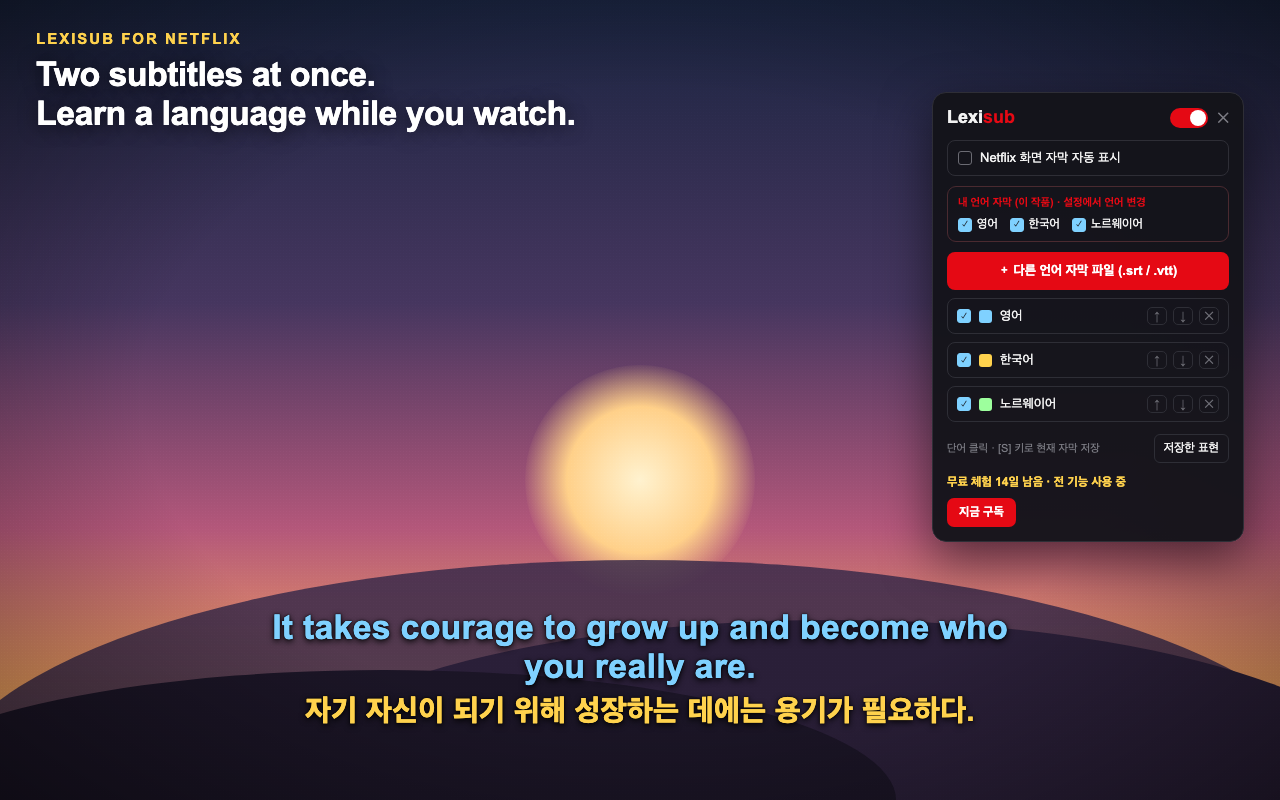
Netflix shows only one subtitle track at a time. Lexisub is a Chrome extension that puts several official Netflix subtitle tracks on screen together, synced to the video. You choose the order and color of each line, can hide the support line with one click for a second pass, and save the current line with a single key for later review. If you want the full setup, the guide to multiple subtitles on Netflix walks through it step by step.
FAQ
Are bilingual subtitles better than target-language subtitles alone?
It depends on your level. Target-language subtitles alone are the strongest option once you can follow most of a scene, because they force you to connect sound and spelling in the language you're learning. Below that point, bilingual subtitles keep the content comprehensible, so you keep watching and keep absorbing. Many learners start with both lines and gradually hide the native-language line.
Won't I just read my own language and ignore the other line?
That is the main risk, and it's real. Your eyes go to the line that costs the least effort. Make the target language the primary line, use the native line only to check meaning, rewatch short scenes, and hide the native line entirely on a second pass.
Does Netflix support bilingual subtitles?
Netflix displays one subtitle track at a time. To see two languages together you need a browser extension such as Lexisub, which shows multiple official subtitle tracks at once, synced to the video.