Guide
Learn a Second Language Through English on Netflix
Most language advice assumes your mother tongue is the language you translate from. But for a huge share of the world, the language you actually think and read fastest in isn't your first language—it's English. If English is your bridge, Netflix plus dual subtitles is one of the most natural ways to reach your next language. Here's how to do it.
There are two very common learners that almost no language tool is built for—yet together they number in the hundreds of millions.
The first is the second-foreign-language learner. Someone in Seoul, São Paulo, Jakarta, Cairo, or Mumbai who studied English for years, reads it comfortably, and now wants to pick up Spanish, Japanese, or French. Their mother tongue is Korean or Portuguese or Indonesian—but English is the foreign language they've already conquered. When they open a study app, everything is framed as "English speaker learns X." They aren't English speakers. English is their tool, not their home.
The second is the English-speaking newcomer. Someone who moved to Germany, Norway, Korea, or Japan for work, study, or family, and speaks solid English but almost none of the local language. They don't need to pass an exam—they need to understand the neighbor, the pharmacist, the parent-teacher meeting. They need real, spoken, everyday language, fast.
Both of these learners have the same secret weapon and the same problem. The weapon: English is the language they can lean on. The problem: almost nothing is designed to pair English against a target language in a way that feels natural. That's exactly the gap Netflix and multiple subtitles fill.
Why English Is the Perfect Bridge (Even If It's Not Your First Language)
Pick any show on Netflix and check the subtitle menu. You'll notice something: English subtitles are almost always there. Subtitles in Korean, Vietnamese, Turkish, or Norwegian? Often missing, especially for content that didn't originate in that market. Netflix built its subtitle pipeline around English as the global hub, which means English is the one line you can count on for nearly the entire catalogue.
That single fact makes English the most practical anchor language on earth for this kind of learning. If you're a Brazilian learning Japanese, Netflix probably won't give you a Portuguese subtitle for a Japanese drama—but it will give you Japanese and English. If you're an American living in Oslo, Netflix will happily show you Norwegian audio with English subtitles. The pairing you need already exists; you just need a way to see both lines at once.
The key idea: You don't learn through your mother tongue. You learn through your strongest language. For a large part of the world, that's English—and English is the subtitle Netflix reliably provides. Pairing "target language + English" turns that coincidence into a study method.
There's a second reason English works so well as a bridge: you read it fast enough that it doesn't break immersion. The whole point of learning from TV is comprehensible input—understanding most of what you hear so your brain can fill in the rest. If you're glancing at an English line you can absorb in a fraction of a second, you stay in the flow of the scene. Your attention stays on the target language, and English does its job quietly in the background.
Group 1: The Second-Foreign-Language Learner
Say you're Korean, you're fluent enough in English to watch American shows without subtitles, and you're starting Spanish. The classic problem: Korean-Spanish learning resources are thin, and Netflix rarely offers Korean subtitles for Spanish content. But Spanish–English? Everywhere.
So you flip the setup. Put the Spanish subtitle on top and the English subtitle underneath. Now you're doing something powerful: you're learning Spanish through the lens of a language you already handle with ease. You're not translating Spanish → Korean → understanding. You're going Spanish → English → understanding, and that middle step is nearly instant because your English is strong.
This is how a lot of the world's polyglots actually operate. Once you have English as a solid second language, every additional language becomes easier to attach to English than to your mother tongue—because English is where most of the world's learning material, media, and subtitles live. Netflix is simply the richest, most enjoyable stream of that material.
Group 2: The English-Speaking Newcomer
Now flip the roles. You speak English natively (or near-natively) and you've just landed in a country whose language you barely know. Textbooks feel slow and unreal—nobody talks like the dialogues in a beginner workbook. What you need is the language as it's actually spoken: the filler words, the polite forms, the way people actually greet each other and complain about the weather.
Netflix has an enormous library of local content in most countries. Moved to Korea? K-dramas and variety shows. Norway? Norwegian series and films. Spain, France, Germany, Japan—each has a deep local catalogue. Put the local language on one line and English on the other, and every episode becomes a lesson in the exact language you'll use tomorrow.
The advantage for immigrants specifically is relevance and speed. You're not learning abstract vocabulary; you're hearing the greetings, the numbers, the shop phrases, the small talk, over and over, in context, from people who sound like the people around you. Save the phrases that keep coming up, review them, and within weeks you'll start catching them in the wild.
A note for expats: Start with content set in everyday life—dramas about families, workplaces, or friendships—rather than crime thrillers or fantasy. Everyday-life shows use the everyday-life language you actually need first.
Why Netflix + Dual Subtitles Beats an App
Flashcard apps and grammar drills have their place, but they teach language in isolation—stripped of tone, rhythm, and context. Netflix does the opposite. It delivers language the way you'll really meet it: fast, emotional, cultural, and connected to a story you actually care about. Your brain remembers a phrase a character shouted in a tense scene far better than the same phrase on card #438 of a deck.
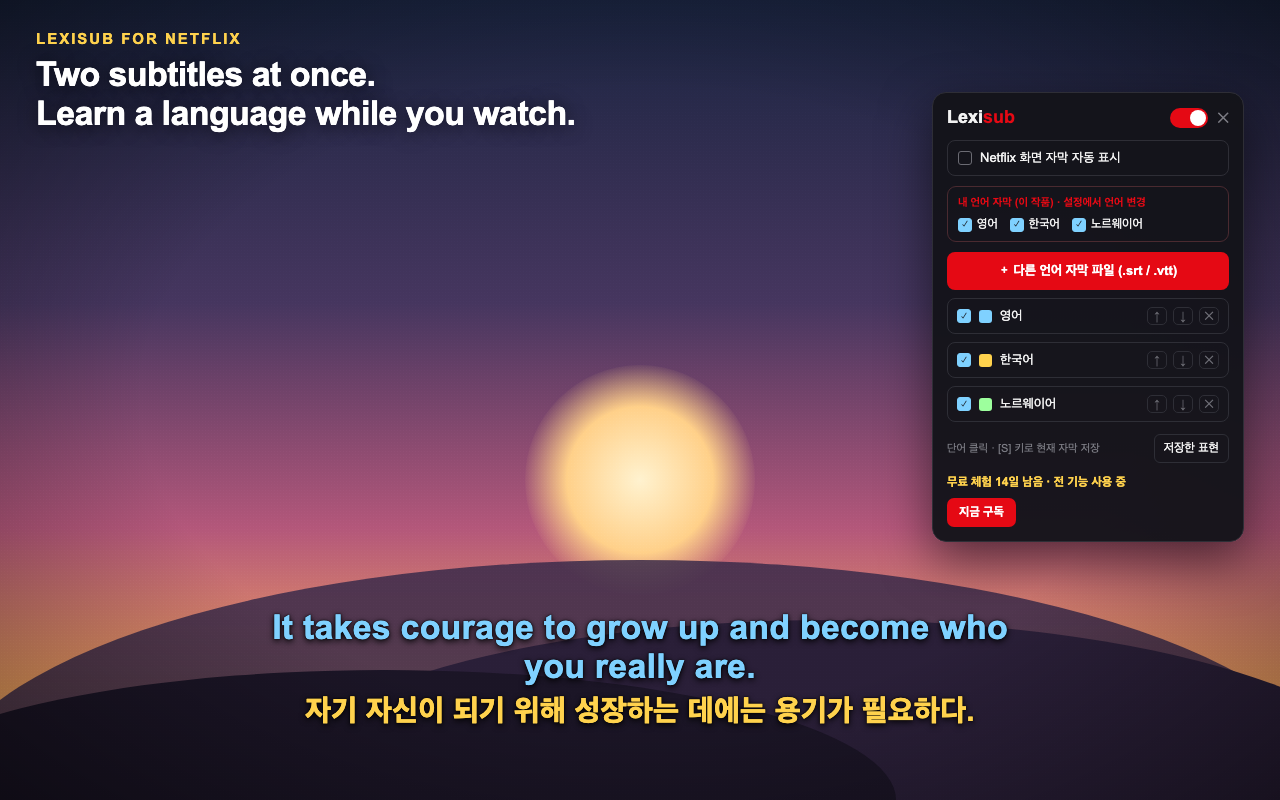
The one thing Netflix doesn't do on its own is show two subtitle lines at once. Natively, you get exactly one. That's the missing piece—and it's the piece Lexisub adds.
How to Set It Up With Lexisub
Lexisub is a Chrome extension that lays multiple synced subtitle lines directly over the Netflix player. Setup takes a couple of minutes:
- Install Lexisub from the Chrome Web Store and open Netflix.
- Pick your two lines. Put your target language on one line and English on the other. On Netflix, Lexisub reads the show's official subtitle tracks, so you're choosing from the languages the title actually offers—and English is almost always among them.
- Adjust the look. Set a comfortable font size and position so both lines are easy to read without crowding the picture.
- Save phrases as you watch. Press the save shortcut (default s) whenever a line is worth keeping. Everything lands in your saved-phrases dashboard, where you can search, review, and export to CSV or Anki.
- Missing a track? If a title doesn't offer the subtitle you need, Lexisub can generate one using your own DeepL, OpenAI, Google, or other provider key—so even rare language pairs are covered.
The interface itself is available in 12 languages, so if English isn't your first language you don't have to navigate settings in English to get started.
Ready to learn through English?
14-day full free trial. Interface in 12 languages. Cancel anytime.
Get LexisubA Simple Routine That Works for Both Groups
You don't need a complicated system. Twenty focused minutes a day beats a marathon session once a week.
- Watch a short segment (10–15 minutes) with target language + English on screen. Don't pause constantly—let the story pull you along.
- Save 3–5 phrases that surprise you, repeat, or feel immediately useful. Quality over quantity.
- Rewatch the same segment the next day. Your brain already knows the plot, so it can spend its attention on the language. You'll catch far more the second time.
- Review your saved phrases once or twice a week. Read them out loud. Notice which ones you now recognize instantly.
For the second-language learner, this quietly stacks a third language on top of your English. For the newcomer, it converts your evenings on the couch into practical fluency in the language outside your window.
The Honest Version
None of this makes you fluent in a week. What it does—reliably—is turn something you already do (watch Netflix) into real, contextual language practice, using the bridge language you already own. For the person who thinks in English and reaches for a third language, and for the person who arrived speaking only English and needs the local language to live, that bridge is the whole game. Netflix supplies the input. Dual subtitles supply the scaffolding. You supply the twenty minutes.
FAQ
My mother tongue isn't English. Can I still learn this way?
Yes—this method is built for exactly that situation. If English is the foreign language you already read comfortably, use it as your anchor line and put your new target language on the other line. You learn language C through the English you already command, instead of routing through a mother-tongue subtitle that Netflix often doesn't even offer. Millions of learners worldwide reach their second and third languages this way.
I just moved abroad and need practical daily language fast. Will TV actually help?
It helps because it gives you the language people really speak—contractions, slang, tone, and the phrases that never appear in a textbook. Watch local shows from your new country with the local language on one line and English on the other. You'll start recognizing the phrases you hear at the shop, at work, and on the street. Pair it with saving phrases so your first vocabulary list comes from real, useful dialogue rather than word lists.
Does Netflix offer subtitles in every language pair?
No—and that's the core reason to pivot through English. Netflix reliably provides English subtitles for the vast majority of its catalogue, while subtitles in smaller mother-tongue languages are often missing. English is the one line you can almost always count on, which makes it the most practical bridge. When a track is missing entirely, Lexisub can generate subtitles from your own DeepL, OpenAI, Google, or other provider key.