Method
How to learn a language with Netflix (a real method)
“Just watch with subtitles” is the advice everyone gives and almost nobody benefits from. Here's the version that actually works — backed by how language acquisition happens, and built around the shows you'd watch anyway.
Netflix is a near-perfect language resource: thousands of hours of native speech, real accents, slang, and context — in dozens of languages. The problem isn't the material. It's the method. Watch passively with native-language subtitles and you'll finish a whole series having learned almost nothing. Here's how to fix that.
The principle: make the input comprehensible
Languages are acquired by understanding messages — what the linguist Stephen Krashen called comprehensible input. The sweet spot is content slightly above your level, where you grasp most of it and stretch for the rest. Two things make Netflix comprehensible:
- Multiple subtitles so you can read the target language and check meaning the instant you're lost.
- The right show — clear dialogue, a level you can mostly follow, a story you actually want to finish.
Get those two right and watching stops being entertainment-with-guilt and becomes practice.
The 4-step method
- Turn on multiple subtitles. Put the target language and your native language on screen at once. Read the target line first; glance at the translation only when you need it. (Here's how to get multiple subtitles on Netflix.)
- Watch a scene normally. Don't pause every five seconds — let the story carry you. You're training your ear as much as your eyes.
- Save the lines that teach you something. When a phrase is useful, common, or just clicked, save it. With Lexisub you click a word or press a shortcut and the whole line is stored in both languages — no pausing to type notes.
- Review later, actively. Once a day, go through your saved phrases. Export them to Anki for spaced repetition, or loop the original clip in study mode and shadow the line out loud.
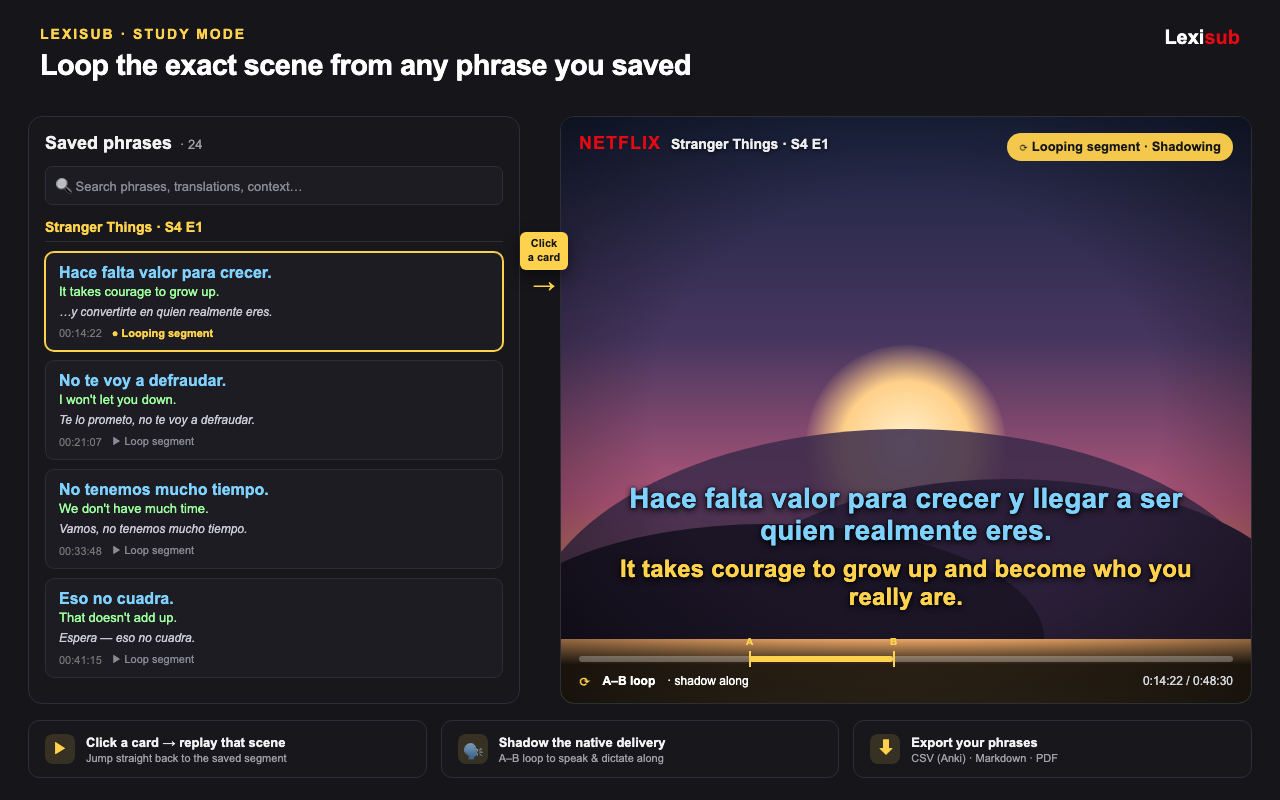
Why saving matters: input builds recognition; review builds recall. Watching teaches you to understand a phrase; revisiting it a few times over the next week is what makes you able to produce it. The save-and-review loop is the difference between “I've seen that word” and “I can use that word.”
Active vs. passive: pick per session
You don't have to study every minute. Mix two modes:
- Active sessions — short (20–30 min), multiple subtitles on, saving phrases, re-watching tricky lines. This is where learning happens.
- Passive sessions — watch a show you've already studied, target-language subtitles only (or none). This consolidates and builds listening stamina.
A good rhythm: one active episode, then re-watch passively. The second pass feels easy — that is the progress.
The best Netflix shows to learn with
The ideal first show has clear, everyday dialogue and isn't too fast. A few reliable starting points by language:
| Language | Easier start | Once you're comfortable |
|---|---|---|
| Spanish | Extra (sitcom, made for learners), Club de Cuervos | La Casa de Papel, Élite |
| French | Lupin, Dix pour cent (Call My Agent) | Marseille, Family Business |
| Korean | Crash Landing on You, Hometown Cha-Cha-Cha | Squid Game, Kingdom |
| Japanese | Aggretsuko, Midnight Diner | Alice in Borderland, Terrace House |
| German | How to Sell Drugs Online (Fast) | Dark, Babylon Berlin |
Rule of thumb: comedies and dramas about ordinary life teach the most useful language. Crime thrillers are gripping but front-load vocabulary you'll rarely say out loud. Start with how people actually talk.
A realistic weekly routine
- 4–5 active episodes a week, multiple subtitles on, saving 5–10 phrases each.
- 10 minutes of review daily — Anki or study-mode loops of what you saved.
- 1–2 passive re-watches for listening, subtitles dialed down.
That's a few hours a week, most of which you'd have spent watching TV anyway. The only added effort is the saving and the review — and that's exactly the part that compounds.
Turn your watchlist into a syllabus
Lexisub gives you multiple subtitles, one-click phrase saving, and a study mode — all on the Netflix you already watch. 14-day full free trial.
Get LexisubFAQ
Can you really learn a language just by watching Netflix?
Watching alone builds vocabulary and listening slowly. It works far better when you make the input comprehensible with multiple subtitles and actively save and review the phrases you meet.
Target-language or native-language subtitles?
Both, at once. Read the target line and check meaning instantly in your native language — that way you learn the original wording, not just a translation.
What level do I need?
Any level, with the right show and multiple subtitles. Beginners should pick slower, dialogue-driven series and lean on the save-and-review loop.