Perspective
Why Netflix Language Learning Is Taking Off — And What Makes Lexisub Click
Something has shifted in how people study languages. The streak-and-gems apps that dominated the last decade are losing their grip, and learners are drifting toward the thing they were already doing every night: watching shows. Here's our read on why that's happening — and, honestly, which design decisions seem to be the reason people keep Lexisub installed.
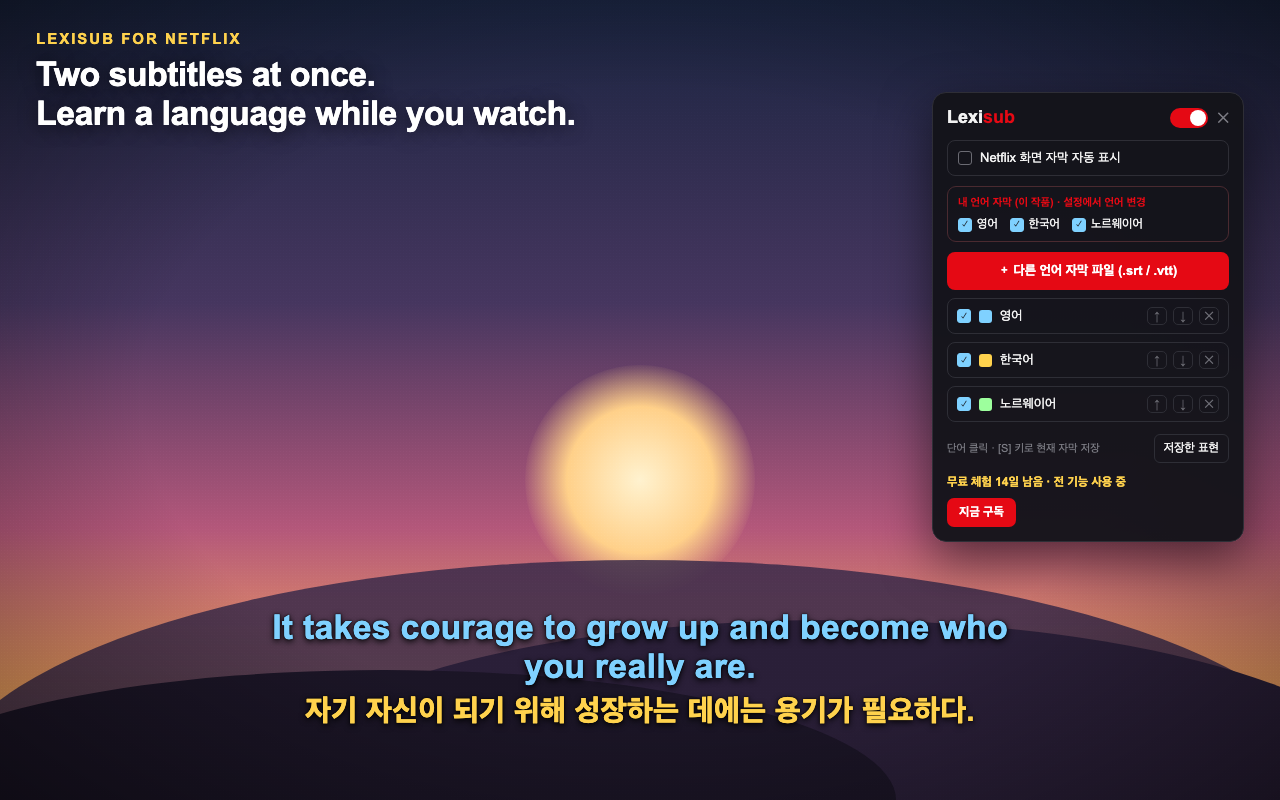
We build a small Chrome extension that puts two subtitle lines on Netflix at the same time. That's the whole product. It's a narrow tool, and narrow tools only survive if they solve something people actually feel. So we spend a lot of time asking a simple question: why does this particular idea resonate right now?
1. The gamified-app era hit its ceiling
A whole generation of learners spent years building streaks. Then a lot of them noticed the same uncomfortable thing: after 500 days of tapping through exercises, they still froze when a native speaker actually spoke. The apps were excellent at retention — their retention — and much weaker at producing people who could follow a conversation.
That disillusionment created an opening. Learners started looking for input that behaves like the real thing: messy, fast, emotional, full of slang and interruptions. Not sentences engineered for a lesson. Native media is the most available source of that on earth, and most people already have a subscription to it.
2. "Comprehensible input" went mainstream
The idea itself isn't new — it's decades old in linguistics — but it escaped academia and became something ordinary learners talk about. The core claim is simple: you acquire a language mostly by understanding messages, not by memorizing rules. What matters is that the input is just above your level: hard enough to stretch you, easy enough to follow.
That reframing is what made TV legitimate as a study method instead of a guilty pleasure. But it also exposed the catch. Raw native content is usually way above the learner's level, not just above it. Which means the practical question stopped being "should I watch shows?" and became "how do I make this show comprehensible enough to count?"
That question is the whole ballgame. Everything useful in this space — including what we built — is some answer to "how do I lower the difficulty of native media without ruining it?"
3. Netflix happens to be the ideal training ground
A few things line up unusually well. The catalogue is genuinely multilingual now — Korean, Spanish, Japanese, French, Turkish, and Scandinavian productions are mainstream, not a niche shelf. Subtitle tracks already exist for most titles, professionally timed. Episodes are short enough to study in pieces. And crucially, people are already there. No new habit has to be invented; the habit already exists and just needs to be pointed slightly differently.
The one thing Netflix doesn't do is show more than one subtitle line. You get the target language or a language you understand — never both. So learners were left doing something faintly ridiculous: pausing every few seconds, switching subtitle tracks back and forth, or watching with a phone in one hand and a dictionary open.
4. Why two lines at once changes the experience
The moment both languages are on screen, something specific happens: you stop guessing and you stop stopping. Meaning arrives in the same second as the sound, while the scene, the tone of voice, and the character's face are all still in front of you. That's when a phrase actually attaches to something. Pausing to look up a word breaks exactly the context that would have made it memorable.
It also removes the quiet shame that kills a lot of learning habits. Watching something you only 40% understand feels like failing. Watching the same thing with a support line feels like reading with training wheels — you know you're being helped, but you're moving, and you can feel yourself needing the help slightly less each week.
5. The design decisions people seem to actually care about
When we look at what we chose to build — and what we deliberately refused to build — a few things stand out as the reasons this tool tends to stay installed rather than get tried once and forgotten.
- It rides on official subtitle tracks. The timing is already correct because it's the same timing Netflix ships. Nothing drifts out of sync halfway through an episode, which is the fastest way to make someone quit a subtitle tool.
- Saving a phrase is one keystroke. Press a key, the line is stored with its context. No dialog, no tagging, no interruption. The friction of capture is the reason most people's vocabulary lists die, so we cut it to almost nothing — and made the saved phrases exportable to Anki or CSV, because spaced repetition is what actually makes words stick.
- Bring your own AI key. If a title doesn't offer the language pair you need, you can generate subtitles with your own DeepL, OpenAI, Google, or other provider key. You pay the provider directly at cost instead of paying us a markup on tokens. It's a smaller business for us and a much better deal for the learner.
- Your subtitle files never leave your machine. Files you load are read locally in the browser. We didn't build a pipeline that uploads what you watch, because we didn't want one.
- The interface is in 12 languages. A large share of learners aren't native English speakers — they're using English as a bridge to a third language. Making them navigate an English-only settings panel to study Spanish would be its own small insult.
- The free trial is the whole product. Fourteen days, everything unlocked, no feature crippled. If the thing isn't useful in two weeks of real use, a paywall wasn't going to fix that.
Try it on tonight's episode
14-day full free trial. Interface in 12 languages. Cancel anytime.
Get Lexisub6. Who this seems to click hardest for
Three groups keep showing up in how people describe using it.
The bridge learner. Someone whose first language is Korean, Portuguese, or Indonesian, who already reads English comfortably, and who is now learning a third language. Netflix reliably offers English subtitles when it doesn't offer theirs, so English becomes the anchor line. We wrote a whole piece about learning a second language through English because this pattern is so common and so under-served.
The newcomer abroad. Someone who moved countries with solid English and almost none of the local language, who needs the way people actually speak — not textbook dialogues — and needs it soon.
The plateaued intermediate. Someone who finished the app, can read fine, and still can't follow a normal conversation at speed. For them the value isn't translation; it's ear training with a safety net, plus a way to harvest the specific phrases they keep half-catching.
7. What we think this actually means
Our read is that the shift isn't really about Netflix, and it isn't about us. It's that learners got tired of tools that measure the wrong thing. A streak measures whether you opened an app. A saved phrase you can now recognize in the wild measures whether you're getting better at the language.
Tools that sit alongside real content — instead of replacing it with a simulation of it — are winning because they let the content do the teaching and quietly handle the friction. That's a modest job. We think it's the right one, and we'd rather do that one job unusually well than build another app that congratulates you for showing up.
If you're already watching something tonight, that's the entire prerequisite. Put a second line on screen and see whether the episode feels different.
FAQ
Is watching Netflix actually an effective way to learn a language?
It's effective when the input is comprehensible — meaning you understand most of what you hear. Passive watching of content far above your level does very little. What makes it work is lowering the difficulty: choosing accessible shows, rewatching short segments, and putting a language you already read next to the one you're learning so meaning arrives instantly instead of being guessed at.
Do I need to be advanced to use dual subtitles?
No. Beginners often benefit the most, because the second subtitle line removes the constant pausing and dictionary lookups that make native content exhausting early on. Start with short segments of familiar or slower-paced shows and rewatch them, rather than pushing through a full episode.
How is this different from just turning on Netflix subtitles?
Netflix shows exactly one subtitle line at a time, so you see the target language or your own — never both. Dual subtitles put the two on screen together, synced to the official tracks, so you read the meaning without leaving the scene. Saving a phrase in one keystroke and reviewing it later is the second half of the difference.